Iqamah Times Explained: Fixed, Offset and Seasonal Schedules
Fixed, offset or seasonal — a plain-English guide to the three ways mosques set iqamah times, and how to keep your congregation in step.
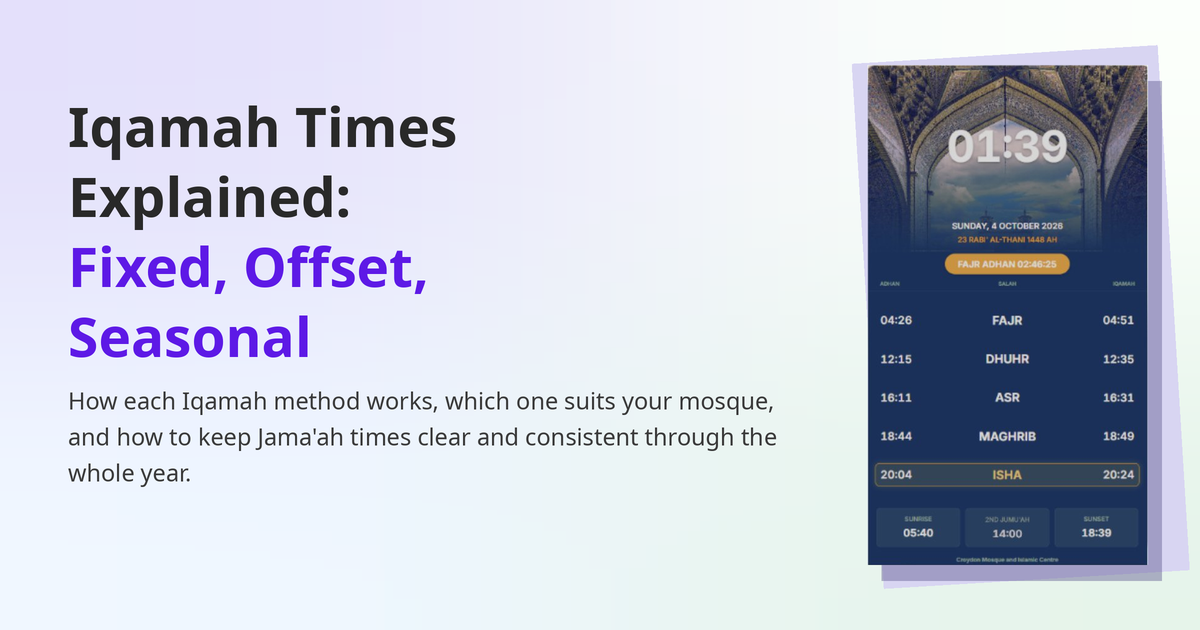
Every mosque committee has had this conversation: "What time is iqamah for Fajr this week?" Someone checks the printed timetable, someone else remembers it changed last month, and a third person is sure it is still the old time. The confusion is not anyone's fault. Iqamah — the second call that starts the congregation prayer — is set by the mosque, not by the sun, and different mosques set it in different ways.
This guide explains the three ways mosques usually set iqamah, when each one works best, and how to keep the whole congregation in step once you have chosen.
First, the two times to keep separate
Adhan time is when the prayer time begins. It is calculated from the sun — dawn for Fajr, the sun's position for Dhuhr, sunset for Maghrib — using a recognised calculation method (such as ISNA, MWL, Makkah, Karachi or Diyanet) and your mosque's location.
Iqamah time is when the congregation actually stands to pray. The mosque decides it. It is always after adhan, and the gap exists so people have time to arrive, make wudu and find a place. A mosque can change its iqamah policy without changing its prayer-time calculation — and that is exactly where most of the confusion comes from.
Method 1: Fixed iqamah
The simplest approach: iqamah is at the same clock time all year round. Fajr iqamah at 6:00 am, Dhuhr at 1:30 pm, Isha at 8:30 pm — whatever the committee chose — no matter what the adhan time does.
Why mosques choose it: it is easy to remember, easy to print, and regulars build their day around it. For Dhuhr and Asr, which move relatively little through the year, a fixed time often works well for months at a time.
Where it breaks: it cannot work for every prayer all year. In summer, Fajr adhan can fall well before a fixed iqamah time that was set in winter — or, worse, a fixed iqamah can fall before adhan if the prayer time moves past it. A fixed time also has to be reviewed when the clocks change. Fixed iqamah is a decision that needs a calendar reminder, not a decision you make once and forget.
Best for: Dhuhr and Asr in mosques that want a rock-steady routine, with a review date written into the committee's calendar — at least at the clock change, and ideally at each season.
Method 2: Offset iqamah (minutes after adhan)
The most common approach in the UK and Europe: iqamah is a fixed number of minutes after adhan. Maghrib iqamah 5 minutes after adhan, Isha 15 minutes after, Fajr 20 minutes after — the mosque picks a gap per prayer, and the clock time follows the sun.
Why mosques choose it: it is self-correcting. When adhan moves earlier in summer, iqamah moves with it, so the gap the congregation expects never changes. Nobody has to remember to update anything when the seasons turn, and the printed timetable stays correct because it is calculated, not typed.
Where it breaks: the gap itself still needs judgement. Five minutes after Maghrib adhan is usually enough — people are already in the mosque for sunset — but five minutes after Fajr adhan in winter would leave most of the congregation outside in the dark. A single gap for all prayers is almost never right; each prayer needs its own. And an offset only works if the adhan times themselves are accurate for your location and method — a wrong calculation method shifts everything, iqamah included.
Best for: most prayers, most of the year — especially Maghrib, Isha and Fajr, where the adhan time moves a lot and the congregation needs the schedule to move with it.
Method 3: Seasonal schedules
Many mosques use a hybrid: a timetable that changes by season or by month. Summer Fajr iqamah is one time, winter Fajr iqamah another; Ramadan has its own schedule entirely, with Taraweeh after Isha.
Why mosques choose it: it matches how people actually live. In summer, a very early Fajr iqamah would empty the mosque; in winter, a late one wastes the morning. A seasonal schedule lets the committee be generous where the congregation needs time, and tight where the prayer time itself is short — Maghrib in summer, for example, leaves little room between adhan and the next prayer.
Where it breaks: it is the hardest to communicate. A timetable that changes four times a year is a timetable people stop trusting — unless the change is announced clearly, in advance, and everywhere at once: on the screen, on the website, and at the door. The changeover dates themselves become a job: someone has to remember to switch, and someone has to check the new times actually appeared.
Best for: Fajr and Isha, where the seasonal swing is largest, and for Ramadan — provided the mosque has a reliable way to publish the change on the day it happens.
Which method should your mosque use?
There is no single right answer — it depends on your congregation, your building, and who does the admin. A few questions that usually settle it:
- How much does each prayer time move where you are? In northern latitudes the swing is large, so fixed times need the most maintenance and offsets do the most work.
- Who updates the timetable, and how often will they really do it? Be honest. A seasonal schedule that nobody updates is worse than a simple offset that updates itself.
- What do your regulars expect? Older congregations often prefer a fixed time they can memorise; younger ones check the screen or the website and follow whatever it says. The screen, if it is accurate, can carry either group.
- What happens in Ramadan? Whatever you choose for the rest of the year, Ramadan will need its own schedule — Taraweeh timing, a different Isha iqamah, and Suhoor/Iftar times on display. Decide that separately, in advance.
A common, practical combination: offsets for Maghrib, Isha and Fajr (so they track the sun), fixed times for Dhuhr and Asr (so the daytime routine stays steady), and a seasonal review of the fixed times at each clock change. Whatever you choose, write it down — the method, the gaps, and the review dates — so the next committee inherits a policy, not a mystery.
How this works in practice with MinarOS
MinarOS is built around the way mosques actually set these times, rather than forcing one method:
- Prayer times are calculated, not typed. The Prayer Calculation Engine supports the standard methods (including ISNA, MWL, Makkah, Karachi, Egypt, Tehran and Diyanet), so adhan times are right for your location before iqamah is even considered. Times can also be imported from the Aladhan API, or entered and edited by hand in the monthly prayer table when the committee wants a specific adjustment.
- Iqamah is set per prayer, per your policy. Fixed times, offsets after adhan, or a seasonal timetable — the monthly table is editable, so a committee decision becomes the mosque's actual schedule instead of a note in a meeting minute.
- The congregation sees a countdown, not a timetable. The TV screen shows the next prayer and a live iqamah countdown, so nobody has to work out whether the printed sheet is this month's or last month's. When the committee changes a time in the panel, the screens update — including offline, since the TV client keeps working without internet.
- Jumu'ah and Ramadan are handled as their own cases, with their own times on the screen, rather than squeezed into the daily pattern.
The point is not the feature list. It is that the schedule the committee agreed is the schedule the congregation sees — on every screen, on the day it changes, without anyone having to reprint anything.
A short checklist before you publish your next timetable
- Confirm your calculation method and location are right — every iqamah decision sits on top of them.
- Decide the method per prayer (fixed, offset or seasonal) and write the gaps down.
- Check the edge cases: does any fixed iqamah fall before adhan at any point in the year? Does Maghrib leave enough time in summer?
- Set the review dates now — clock changes, season changes, and Ramadan — with a named person for each.
- Publish the change everywhere at once: screens, website, and a notice at the entrance. One place updated is no place updated.
Get those five right and the weekly "what time is iqamah?" conversation quietly disappears — which is, after all, the whole point of a timetable.
If you would like to see how the countdown and the monthly prayer table look on a real mosque screen, the Smart TV service page shows the MinarOS display, and the Prayer Engine page explains the calculation methods in more detail.