Paper Notice Board vs Digital Mosque Signage: An Honest Comparison
An honest comparison of the paper mosque notice board vs a digital screen — where paper wins, where it fails, and what changes. Costs included.
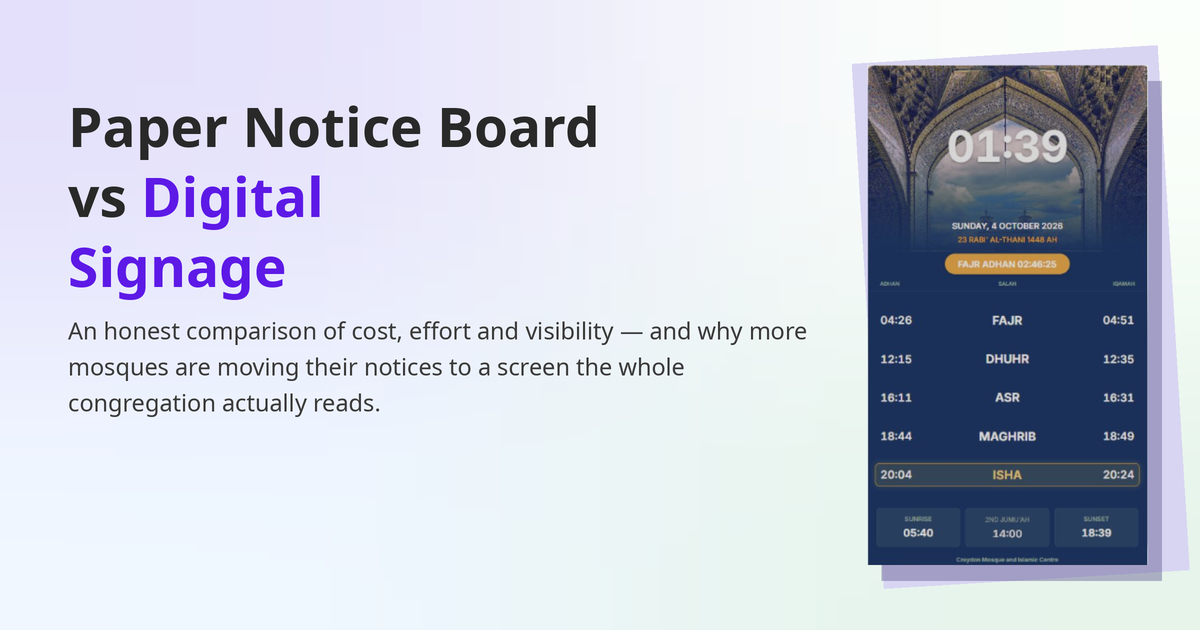
Every mosque has one: the notice board by the entrance, layered with printed sheets — a class timetable from two terms ago, a faded appeal poster, last month's janaza announcement still pinned in the corner. Nobody maintains it on purpose; it just slowly becomes wallpaper.
Digital signage promises to fix that. But is it actually worth it for a mosque? This article compares the two honestly — where paper genuinely wins, where it quietly fails, and what changes when the board becomes a screen.
Where the paper board honestly wins
Let's give paper its due:
- It costs almost nothing. A cork board, pins and a printer. No subscription, no setup.
- Anyone can use it. No passwords, no training. If you can print, you can post.
- It never crashes. No Wi‑Fi, no updates, no "the screen is frozen again."
- It suits very small mosques. A small musallah with one weekly notice may truly not need more.
If your mosque has a handful of notices a month and someone reliable who keeps the board tidy, paper works. The problems start with scale — and with time.
Where paper quietly fails
Nobody reads it. Worshippers walk past the board at the busiest, most distracted moment — arriving or leaving. A board that never changes trains people not to look at it at all.
Old notices never die. An appeal that ended in March is still up in June. A changed class time gets a handwritten correction that three people see. The board's information is only as fresh as the last person who bothered — and bothering is nobody's actual job.
Prayer times are always manual. The printed timetable is a photograph of a decision made months ago. When the committee adjusts iqamah for summer, someone must reprint, re-pin, and hope the old sheet came down.
Urgent things can't move fast. A janaza today, a venue change tonight, a water shutdown tomorrow — paper has no answer for same-day news. So the mosque falls back on word of mouth and half the congregation hears it late.
It only exists in one place. The sisters' section, the car park, the madrasah parents who never enter that corridor — none of them see the board.
What a digital screen actually changes
A digital signage screen in a mosque is not really "a TV instead of a board." It changes who has to do work, and when:
| Paper board | Digital screen | |
|---|---|---|
| Updating a notice | Print, travel to the mosque, pin it | Type it once from a phone, anywhere |
| Prayer times | Reprinted by hand each season | Calculated daily, iqamah updates itself |
| Removing old notices | Someone must remember | Notices expire on the date you set |
| Urgent announcements | Word of mouth | On screen within minutes |
| Where people see it | One corridor | Every screen — hall, entrance, sisters' section |
| Running cost | Paper, ink, someone's time | A screen you likely own + a small subscription |
| Failure mode | Slowly goes stale | Needs power/internet for updates (good systems keep working offline) |
The honest catch on cost: digital is not free. If you need to buy a TV, that is a real one-off cost — though most mosques already have a screen, and systems like MinarOS start free for the first screen, so the "subscription vs paper" comparison is often really "a few pounds a month vs a volunteer's hours."
The other honest catch: a screen nobody updates becomes expensive wallpaper, exactly like the board. The difference is that updating a screen takes two minutes from home, so in practice it actually happens.
The middle path many mosques take
You do not have to choose one and burn the other:
- Start with the screen for prayer times only. Accurate, self-updating times are the highest-value job, and the congregation notices immediately.
- Move time-sensitive notices to the screen — classes, events, appeals, janaza announcements — because these are the ones paper handles worst.
- Keep paper for the permanent things — the framed duas, the building's history, the things that never change. Paper is excellent at permanent.
Most mosques find that within a month, the screen is where people actually look — because it is also where the prayer countdown is, and everyone looks at that.
A fair test for your mosque
Before spending anything, ask three questions about your current board:
- When was the oldest notice on it put up? (If you don't know, that's the answer.)
- If iqamah changed tomorrow, how many days until every regular worshipper would know?
- Who, by name, is responsible for the board — and what happens when they're away?
If those answers make you uncomfortable, the board isn't a communication tool anymore; it's decoration. A screen won't fix a mosque's communication by itself — but it removes every practical excuse, and it puts your messages where eyes already are: next to the prayer times.
If you'd like to see what that looks like, the Smart TV service page shows the MinarOS screen designs, and the first screen is free to run for as long as you like.