Ramadan Mosque Operations Checklist: Screens, Timetables, Donations and Volunteers
A practical Ramadan checklist for mosque committees: timetables, TV screens, Taraweeh, Zakat and Fitra, volunteers and Iftar - decided before the month starts.
Ramadan does not arrive gradually. One evening the mosque is quiet, and the next it is full — for Taraweeh, for Iftar, for the last ten nights. The mosques that cope well are rarely the ones with the biggest buildings. They are the ones that decided the timetable, the screens, the donations and the volunteer rota weeks before the first fast, instead of the night before it.
This checklist is for a mosque committee planning Ramadan 2027. The dates below are the expected ones for the UK: the first Taraweeh is expected on the evening of Sunday 7 February 2027, the first fast on Monday 8 February, and Eid al-Fitr around Tuesday 9 March — all subject to the moon sighting, which can shift the start by a day. Your mosque's own announcement is the final word, so treat every date in this guide as provisional until your committee confirms it.
Everything else in Ramadan hangs off the timetable, so settle it first and write it down.
- Confirm the calculation method and location. The prayer times for the whole month sit on top of these two settings. If they are wrong, every Suhoor and Iftar time on the screen is wrong with them.
- Decide Isha iqamah and Taraweeh separately. Taraweeh follows Isha, so a late Isha iqamah pushes the whole night later. Agree both times now, with the imam, and put them in the monthly table — do not leave Taraweeh as a verbal agreement.
- Set Suhoor end and Iftar clearly. The congregation needs one Suhoor-end time and one Iftar time, displayed every day. In 2027 Ramadan falls in winter in the UK, so the fasts are short — around eleven hours — but the times still move day by day, and a printed sheet from last week will be wrong by the end of the month.
- Plan the last ten nights and Jumu'ah as their own cases. Qiyam times, a different Isha iqamah, and the Jumu'ah timetable all need decisions of their own. Decide them now, not when the tenth night arrives.
- Agree who announces the moon sighting — and how. One named person, one channel, one message. If the start date moves by a day, the congregation should hear it from the mosque, not from a rumour.
If your mosque is still arguing about fixed versus offset iqamah, the earlier guide on Iqamah Times Explained covers the three methods and how to choose between them.
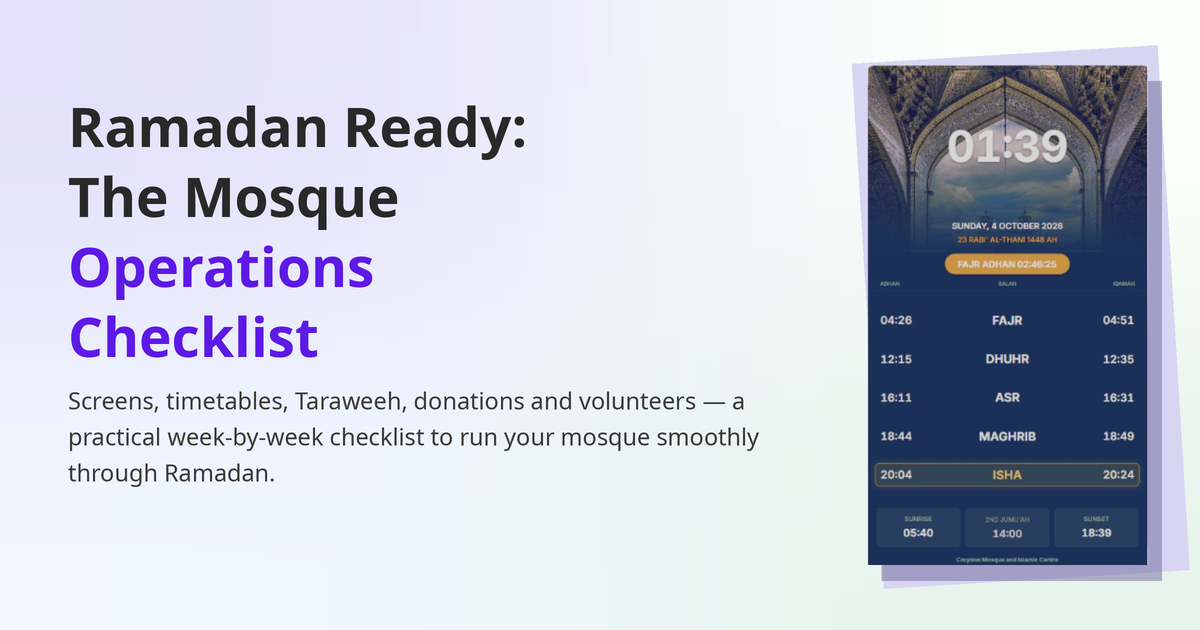
During Ramadan the TV screens stop being a notice board and become the timetable itself. People check them for Suhoor, for Iftar, for Taraweeh — often several times a night.
- Show a Suhoor/Iftar countdown, not just a list of times. A countdown answers the only question anyone is asking: how long until Iftar? A static timetable makes people do the maths themselves, and in a crowded prayer hall nobody does.
- Give Taraweeh its own slot on the screen. Isha iqamah, Taraweeh start, and the number of rak'ahs if your mosque announces it — visible before Maghrib, so people can plan their evening.
- Use the ticker for what changes daily. The day's Hadith, a reminder about Zakat al-Fitr, the Iftar host for tonight, a notice about the last ten nights. The ticker is where the news goes; the timetable stays steady underneath it.
- Test the screens before the first night. Switch on the Ramadan display, check the countdown actually counts down, and check what happens if the internet drops — a screen that goes blank during Iftar is worse than no screen at all. Fix it in the week before Ramadan, when there is time to fix it.
- Decide the look once. One Ramadan theme for every screen, for the whole month. Changing the design mid-month confuses people who navigate by colour and position.
Ramadan is the biggest giving month of the year for most mosques, and it is also the month when donation mistakes cause the most arguments.
- Set up the funds before the first fast. Zakat, Sadaqah, mosque running costs, and Zakat al-Fitr are different funds with different rules. If they are not separated before Ramadan, they will not be separated during it.
- Agree the Fitra amount — and the deadline. The committee decides the amount per person and the last day it can be paid. Announce both on the screens and the website, in good time, and repeat them in the last week.
- Make giving easy at the moment people want to give. A clear route — on the website, at the entrance, after Taraweeh — with a receipt. People give generously in Ramadan; the mosque's job is to make that simple and to record it properly.
- Keep the public record honest. If the mosque displays fundraising progress, it must show real figures from the finance records, not a target dressed up as a total. Trust built over a Ramadan lasts all year; trust lost over a Ramadan does too.
A full mosque in Ramadan runs on volunteers. Plan them like the timetable — by name, by night, in advance.
- Write the volunteer rota now. Door stewards, car-park helpers, people to set up and clear Iftar, someone to check the screens each evening. A rota with names and nights beats a general appeal for "anyone who can help" every single time.
- Plan Iftar hosting. If families or sponsors host Iftar nights, confirm the dates, the numbers, and who brings what — before Ramadan, not on the day. Put the host's name on the screen for the night, so the congregation knows who to thank.
- Book the hall properly. Iftar gatherings, community events and extra prayers all compete for the same hall. A booking record — who, when, how many — stops two groups arriving for the same room on the same night.
- Think about the whole building. More people means more wudu queues, more shoes at the door, more children in the prayer hall, and more cars outside. A short conversation about each of these now is worth a dozen apologies later.
- Look after the volunteers. The same people who open the mosque at Fajr are often the ones still there after Taraweeh. Share the load across the month, and say thank you in public, not just in private.
Ramadan changes the rhythm of everything the mosque runs, including the madrasah.
- Decide the madrasah timetable early. Shorter classes, a pause, or a move to weekends — whatever the teachers choose, tell the parents before Ramadan, in writing, with the restart date included.
- Keep the children's Ramadan simple. A short daily reminder, a small target for the month, and a celebration at Eid will do more than a complicated programme nobody has time to run.
- Do not let the regular programmes quietly collapse. If a class or a circle is paused for Ramadan, say so, and say when it returns. Silence reads as cancellation.
A timetable change that reaches the screens but not the website — or the website but not the entrance — is a timetable change that half the congregation misses.
- Publish the Ramadan timetable in three places on the same day: the TV screens, the mosque website (announcements and events), and a printed notice at the entrance.
- Announce the big dates in advance: first Taraweeh, the last ten nights, Laylatul Qadr programmes, and Eid prayer. People plan family and work around these; a week's notice is the minimum.
- Keep one person in charge of updates. When the moon-sighting announcement comes, or a time changes, one person updates all three places. Three people updating three places is how a mosque ends up with three different Iftar times.
Six weeks before Ramadan: confirm the calculation method and location, agree Isha iqamah and Taraweeh times, decide the Fitra amount, start the volunteer rota, and test the screens.
Two weeks before: publish the full Ramadan timetable on screens, website and entrance notice. Confirm Iftar hosts and hall bookings. Brief the volunteers.
One week before: check the screens again — countdown, Taraweeh slot, ticker, offline behaviour. Confirm who announces the moon sighting and how.
First night: someone checks that the screens, the website and the entrance notice all show the same times. Fix any mismatch that evening.
Last ten nights: switch to the Qiyam timetable, announce it clearly, and confirm the Eid prayer time.
Eid: publish the Eid prayer time early, celebrate, and thank the volunteers by name.
MinarOS is built for the way a mosque actually runs Ramadan, rather than for an ordinary week:
- Prayer times are calculated, not typed. The Prayer Calculation Engine supports the standard methods (including ISNA, MWL, Makkah, Karachi, Egypt, Tehran and Diyanet), so Suhoor and Iftar times are right for your location. The monthly prayer table is editable, so a committee decision — a different Isha iqamah, a Taraweeh time, a Qiyam schedule — becomes the mosque's actual schedule.
- The screens carry the month. The TV display shows the next prayer with a live iqamah countdown, and the notice ticker carries the daily reminders. When the committee changes a time in the panel, the screens update — including offline, since the TV client keeps working without internet.
- Donations stay separated and recorded. The Finance module keeps Zakat, Sadaqah and Fitra in their own funds, with receipts and a public fund record, so the month's giving is traceable instead of argued about afterwards.
- The hall and the website are part of the same plan. Hall bookings are recorded in the panel, and Ramadan announcements and events go out through the mosque's own Website Builder site — so the screens, the website and the entrance notice can all say the same thing.
- The madrasah is not forgotten. Attendance, fees and classes are managed in the Madrasah module, so a shortened Ramadan timetable is a decision the teachers make once, not a confusion that repeats every week.
The point of all of it is the same as the point of the checklist: Ramadan should be decided in advance, published everywhere at once, and then left to run — so the committee can spend the month in the prayer hall, not in the office fixing timetables.
If you would like to see how the countdown and the monthly prayer table look on a real mosque screen, the Smart TV service page shows the MinarOS display, and the Prayer Engine page explains the calculation methods in more detail.